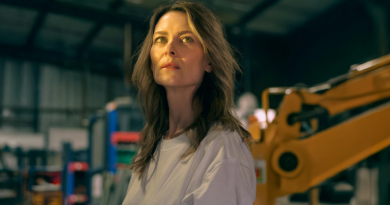

Interview with Gary Abrahams
Fresh from presenting Yentl in London and now celebrating the success of Eurydice at forty five downstairs, director Gary Abrahams finds himself reflecting on imagination, artistic identity and the state of Australian theatre.
Currently playing until 14 June, the production has earned rave five-star reviews and is rapidly selling out as audiences embrace its distinctive and daring interpretation of Sarah Ruhl’s acclaimed work.
While Yentl and Eurydice may appear vastly different works on the surface, Abrahams sees a clear connection between them.
He says:
I’d have to say the thing that connects them is my wild imagination, They are both works that play with form and content in surprising and imaginative ways.
For Abrahams, both productions sit at the intersection of narrative and experimentation. They are visually bold works that combine character-driven storytelling with more abstract theatrical forms, allowing audiences to engage emotionally while embracing ambiguity and theatrical invention.
His recent return from London has only strengthened his appreciation for Australian theatre-making. Although Yentl was originally created in Melbourne, presenting the work overseas and immersing himself in London’s theatre scene offered a valuable perspective.
It made me realise how unique and particular Australian theatre practice is. Australian artists are like little magpies – flying around the world and picking up shiny and interesting things to add to their nests back home.
He believes Australian theatre has developed a distinctive voice through its blend of European, Asian, American and Indigenous influences, resulting in work that is playful, irreverent and uniquely its own.
I’ve returned with a renewed sense of pride in our industry.
That sense of discovery has been central to the rehearsal process for Eurydice. Abrahams describes Sarah Ruhl’s text less as a conventional play and more as a poem—one that reveals new layers the longer artists spend with it.
Every day of rehearsals making Eurydice was a day full of surprises
What initially appeared as a lyrical retelling of the Orpheus myth gradually revealed darker undercurrents.
One of the more surprising things about this work is that it revealed itself to be much darker, more cynical, and more tragic than on early reads.
Those discoveries emerge through a rehearsal methodology that prioritises exploration over certainty. Abrahams actively resists the urge to judge rehearsals as successful or unsuccessful.
Rehearsals, for me, are simply about play,” he explains.
He encourages performers to experiment freely within a framework he establishes, often delaying formal blocking for as long as possible. A personal mantra—”let it be bad”—helps create an environment where failure, frustration and uncertainty become productive creative tools rather than obstacles.
Bad, messy, frustrating rehearsal days often fertilise the work more richly in the long run.”
The approach reflects his broader artistic philosophy. While he begins with a tonal and stylistic direction, he remains open to the discoveries that emerge organically through collaboration.
A successful rehearsal process is one where I’m surprised by the work that has been created.
At the same time, he acknowledges the delicate balance between collaboration and leadership.
It’s a democratic process until it’s not. At some point I have to take the lead, make the choices, enforce my creative aesthetic, and work to my own creative satisfaction.
When considering why Eurydice continues to resonate with contemporary audiences, Abrahams points to the play’s exploration of love, attachment and sacrifice.
True love versus limerence. Holding on versus letting go. And the impossible position of loving an artist.
His advice arrives with a laugh.
Don’t fall in love with artists! They will always have a higher mistress.
Those personal and emotional questions are precisely what attract him to new projects. Rather than searching for scripts that provide all the answers, Abrahams seeks works that invite dialogue.
Is there space within the work for my own imagination?
He is increasingly drawn to texts that leave room for conversation between playwright, director and collaborators rather than functioning as fixed blueprints.
I want to be in conversation with the text, not dictated to by it.
While passionate about the artistry emerging from Melbourne’s independent theatre sector, Abrahams is frank about the challenges facing the industry.
What excites me most is the passion and integrity of our independent scene.
Yet admiration is accompanied by concern.
Theatre simply cannot thrive within a strictly capitalist model.
He points to the vast amount of independent work created through unpaid labour and volunteer effort, describing it as both inspiring and deeply troubling. The reliance on volunteerism risks excluding artists who simply cannot afford to participate.
It’s unsustainable.
As an audience member, Abrahams values theatre that surprises and unsettles rather than neatly explaining itself.
I don’t need to understand everythings. But if I am entranced and mesmerised, and the work is unpredictable, then it imprints upon me.
That desire for unpredictability extends to what he hopes audiences will take away from Eurydice. In fact, he would welcome disagreement.
I hope people have arguments about it.
The production represents a significant departure from previous stagings of the play, and Abrahams is fully aware that it won’t appeal to everyone.
It’s the difference between a Taylor Swift song and some grungy garage band doing their own thing.
The comparison isn’t intended as a value judgement. Rather, it reflects his commitment to making work that embraces risk and individual perspective, even if it proves divisive.
And that little fringe garage band.they’re gonna find an audience excited by their messy, chaotic, wild perspective.
Ultimately, Abrahams wishes conversations about theatre in Australia extended beyond reviews and box-office discussions.
We cringe about art in Australia,Because art is all about the deep stuff, feeling, emotion, psyche, existentialism, symbolism, metaphor, poetics, aesthetics, meaning.
His own work, emerges from a deeply personal place, even when it isn’t autobiographical.
Because I never work in autobiographical form, nobody ever seems to guess that the work I create and make has anything to do with me on a personal level.
For audiences heading into Eurydice, that personal investment may be the most important thing to know. Behind the mythology, experimentation and theatrical invention lies an artist inviting audiences into a conversation, one that doesn’t necessarily require agreement, but certainly rewards engagement.
For more information click HERE